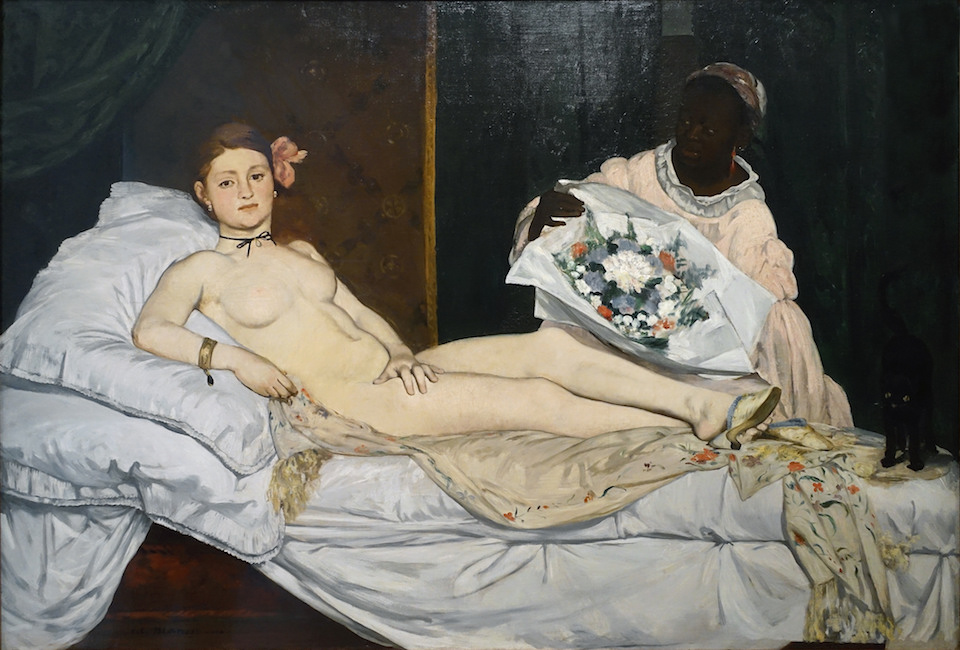
Back in the day, long before Tiffany, Crystal, and Candy became familiar sex worker names, Olympia was already holding the crown thanks to Édouard Manet’s scandalous painting.
What Manet put on the canvas in 1863 was a real woman with a real name, reclining with brazen composure. Venus, deathly pale and almost glowing, lies against a layer of white pillows and sheets. The base of the bed and the background are steeped in darker tones, making her body all the more arresting. Next to her, an attendant presents a bouquet of flowers, perhaps sent by an admirer. But the women are not lost in daydreams. They are looking, one at her mistress, the other directly at us. Olympia, starkly naked except for a black ribbon tied around her neck, a flower in her hair, a bracelet, and the little slipper dangling from her toes, confronts the viewer with awareness. Even the cat confronts the viewer with its awareness – tail up, eyes wide open, standing.
The scene is not sexual, sentimental, or vulnerable even when Olympia’s body is naked, reclining, and appearing to be at rest. It feels charged, even tense. The women are waiting. Olympia’s hand rests firmly over her sex, deliberately, setting her own boundaries. The flowers, presented in full bloom and wrapped in pale sheets, are the most erotic element of the composition, their symbolism hovering between fertility, desire, and commerce. They mirror Olympia herself: fully visible on her own terms.
When the painting debuted at the 1865 Salon, the reaction was explosive. Critics called it obscene, vulgar, and even “a corpse” because of her pallor. What disturbed them was what kind of nude Olympia was. Manet dared to strip away mythological alibis and present a prostitute, recognizably modern, staring at her viewers without shame or subterfuge. This was Venus without allegory. Olympia, unlike Titian’s or Ingres’ goddesses, was not a fantasy for the male gaze but a woman engaged in her own economy of power.
And then there was the presence of her attendant. In the 19th century, Black women in French art were often cast as exotic accessories, reinforcing ideas of otherness. Here, the attendant is composed, observant, fully participating in the scene. Her gaze toward Olympia signals a relationship not of servitude alone but of complicity. These were women sharing awareness of what is expected, exchanged, and unsaid.
For me, this is where the painting’s tension resides: in expectation. The viewer expects Olympia to submit to the familiar role of the passive nude, yet she expects something from us in return, acknowledgment, recognition of her presence, even accountability from a lens of voyeurism. Yet, Olympia negates the voyeurism because she is not lost in reverie but very much here, as is her attendant. Together they resist the polite erasures of romanticized femininity. Prostitution, slavery, women’s labor, subjects often pushed to the margins of “serious” art, are suddenly staring back at us from the canvas.
Manet’s Olympia is riveting because it unsettled and still unsettles propriety by refusing to let its subjects passivity.
 𝐃 𝐗 𝐌 𝐈 𝐍 𝐈 𝐐