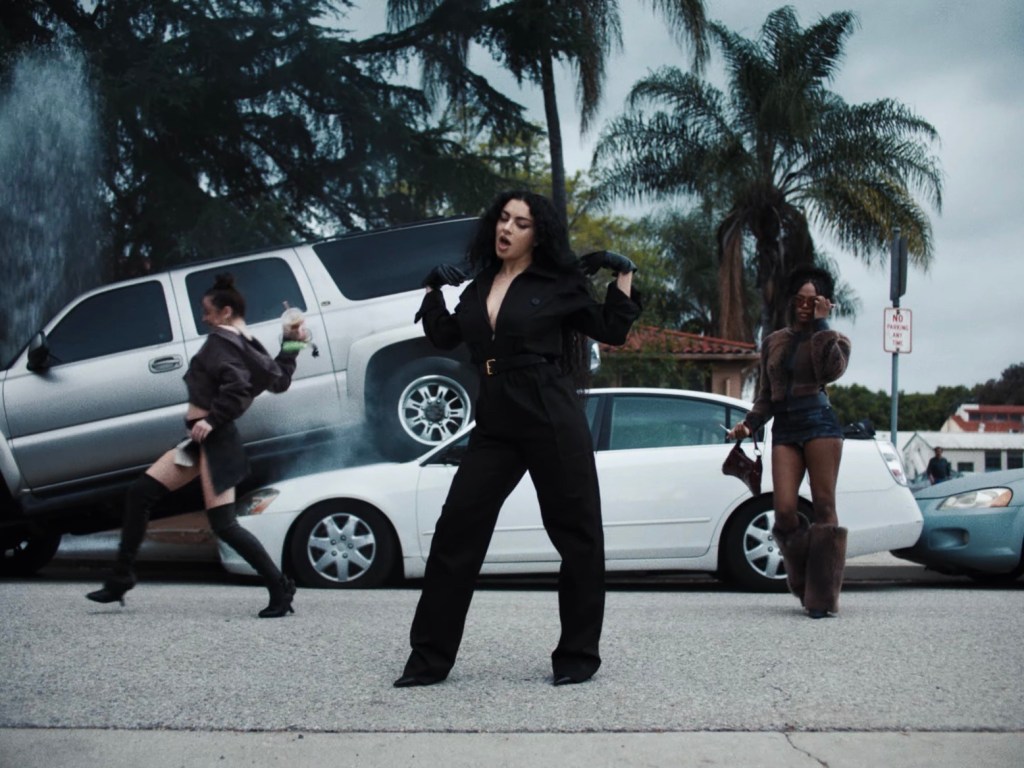
I don’t usually tell people I like anything popular. It’s not rebellion—it’s instinct. But I love popstars. Not pop music, necessarily, but the machinery of it. The myth-making. The kind of woman who enters the room like she invented the door. Reality TV is full of them: women whose every gesture is curated, every meltdown aesthetic. Charli XCX is that kind of popstar, and BRAT is the album that knows it.
There’s no illusion of purity here. BRAT is jagged, bratty, meticulously referential, and fully self-aware. It’s a record for the girls who lift weights in full beat, who cry while fixing their eyeliner, who know that being “too online” is both a curse and a currency. It’s not interested in the cool, aloof detachment of “tasteful” pop. It leans into garishness—ugly synths, screechy loops, glittery threats—and reveals the tenderness inside the chaos.
And yet it’s not soft. Or at least, it doesn’t want to be. When Charli declares “I’m your favorite reference, baby,” she’s not asking for validation. She’s claiming her space as muse and mirror, icon and internet girl. But under every flex is a flinch. The minimalist production and glitchy, industrial edges aren’t just aesthetic choices—they sound like the inside of a tired brain at 3AM. This is music for the overstimulated. For the girl who scrolls too fast, types too much, knows she’s oversharing but posts anyway.
Because that’s what BRAT understands: pop is a performance of power. And power is exhausting.
Across the album, Charli confronts what it means to be a woman in control—of her image, her desire, her grief. In one track, she’s dancing to her own songs all night. In another, she admits she was a shitty friend. The whiplash isn’t chaotic—it’s honest. The internet has made contradictions our native language. Vulnerability is monetized, curated, algorithmically timed. And still, it can cut through.
The album’s emotional core, “So I,” is a direct tribute to SOPHIE, stripped down to aching vocals and a piano that doesn’t try to be poetic. It’s uncomfortable in its plainness. It’s also one of the only moments where the mask drops completely. Elsewhere, emotion is filtered through distortion, irony, and club beats. Grief is a runway. Insecurity is a bassline. Womanhood is a costume you wear until it frays.
And when Charli asks “Should I stop my birth control?” it doesn’t feel like a provocation—it feels like something you whisper to your friend at a party, both of you tipsy, surrounded by strangers, just loud enough to be heard.
BRAT is a portrait of millennial burnout filtered through Gen Z aesthetics. It’s about the pressure to be hot, funny, self-aware, self-deprecating, brandable, mysterious, nostalgic, unbothered, and fully healed—all at once. But it’s also about loving the game, even as it drains you. Charli isn’t saying she’s above it. She’s just showing you what it does to her, in neon green.
This is not an album for the tasteful. It’s for the girls who pose and collapse. Who throw parties and then spiral in the Uber home. Who know the difference between sincerity and performance—and choose both anyway. It’s the soundtrack to a meltdown in designer heels. And it’s one of the smartest pop albums of the decade.

Read the full review on my website.
 𝐃 𝐗 𝐌 𝐈 𝐍 𝐈 𝐐