For your repertoire…
I never cared about the Kardashians. Not really. Not until 2020, when I found myself immobilized in a hospital bed, stitched up after surgery, surrounded by the antiseptic cold of machines and silence. I was there longer than I expected—days turned gelatinous, time pooled at the corners of the room, and my body pulsed dully beneath a cocktail of oxycodone, neurontin, and melatonin. Everything was both too sharp and too soft.
At first, I let the Food Network run. It was always the same segment—festival food, shot in golden, greasy glory. Deep-fried butter, novelty churros, turkey legs. I watched until it made me sick. I turned the channel in a stupor and stumbled into Keeping Up with the Kardashians.
I stayed, not out of interest, but because their show offered a kind of padded quiet. They rarely did anything—just talked, mostly. In open-concept kitchens. On white leather sofas. To each other, and to the camera. They summarized their own lives in a loop. Their voices were modulated, their conflicts strangely bloodless, and the editing always returned us to calm. It was a safe, glossy blur, a kind of narcotic of its own.
I watched through a pharmacological haze, lulled by the rhythm of their language and the sterile drama of their lives. At some point, the background noise began to cohere into curiosity. I started to notice Kim.
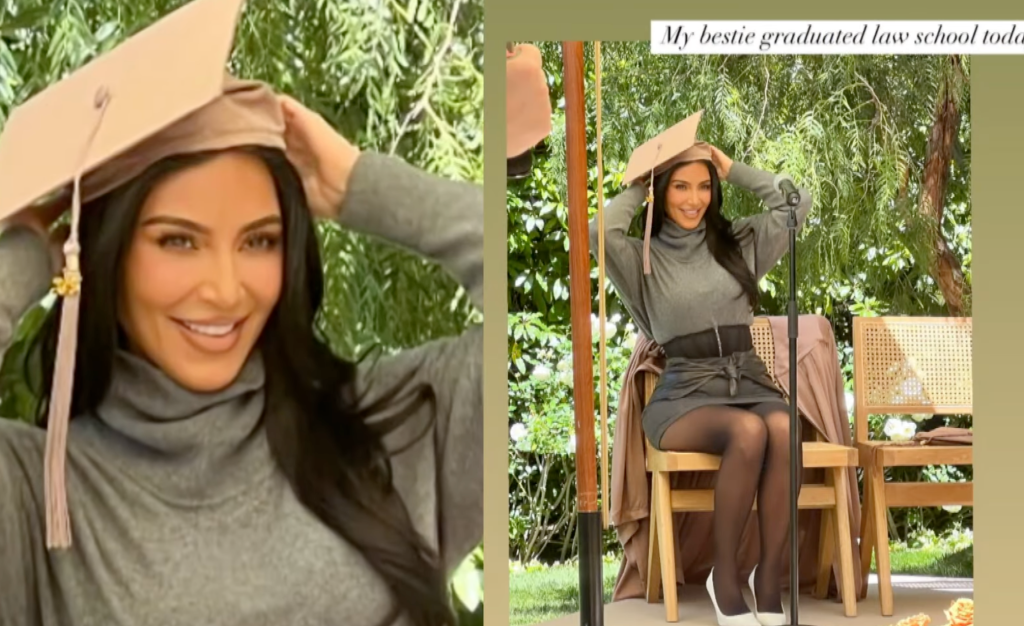
Kim Kardashian had been there all along. A shadow figure in early 2000s tabloid culture, standing next to Paris Hilton, and then, suddenly, standing alone. Her body, her story, her image had been made endlessly visible—first as scandal, then as object, then as brand. Watching her, I began to understand that her role in the cultural imagination was never just personal. It was mythological.
Her body became a site of projection, repetition, even punishment. Julia Kristeva’s theory of abjection describes a reaction to what we cannot fully reject because it remains disturbingly familiar. The abject is that which disturbs identity, system, and order. In the early years of Kardashian fame, Kim became a living emblem of that abjection. She was too much. Too sexual, too artificial, too visible. And yet she could not be ignored. The culture kept her close in order to disavow her, obsessed with her in order to condemn her.
Her evolution as a public figure can be read through the music videos that featured her, where her image functioned as a kind of ideological barometer.
In Fall Out Boy’s “Thnks fr th Mmrs” (2007), she appears as a cipher: a stylized love interest handled by chimpanzees, directed, moved, posed. She is objectified twice over—first by the fictional directors, then by the camera itself. It’s satire, but the joke is that the woman is never in control. Her silence makes her readable only in relation to male performance. This is Laura Mulvey’s male gaze in full operation—Kim is not a subject with agency, but an image orchestrated for desire.
In Kanye West’s “Bound 2” (2013), she is placed at the center of a romantic narrative. Her body is aestheticized—topless, riding on a motorcycle across a dreamlike landscape. Here, she is elevated, but still curated. She is the beloved object, the muse, the fantasy made literal. Her sexuality is reabsorbed into the logic of monogamy and artistic devotion. The female body is no longer scandalous—it is transcendent, but only through male vision.
Then, in Fergie’s “M.I.L.F $” (2016), we see a shift. Kim appears powerful, commanding. She struts in latex, pours milk over herself, and poses like a pin-up CEO. The video flaunts hyper-femininity as domination: motherhood, sexuality, and wealth synthesized into a spectacle of agency. It seems to assert feminist control, but it remains mediated. Kim becomes a symbol of aspirational womanhood, not necessarily a woman herself. She is empowered, but still aestheticized, commodified, abstract.
Kristeva’s notion of the semiotic, the chaotic, pre-linguistic current beneath structured meaning, offers a way to understand this tension. Kim’s power lies in her resistance to simple narrative. She oscillates between subject and object, sacred and profane, feminist and capitalist icon. She is a vessel for contradiction, always slipping past the categories she seems to inhabit.
By the time I was discharged from the hospital, I had watched hours of her. I realized that Kim Kardashian functions not just as a celebrity, but as a language, a visual code for the way culture negotiates women’s visibility, autonomy, and worth. We have come a small way from the cruelty of the early 2000s, when women were chewed up by paparazzi flashbulbs and spat out on gossip blogs. But the shift is incremental. An inch forward, maybe. The violence is now subtler, folded into branding, softened by the language of choice.
Still, an inch forward is not nothing. It marks the distance between where we were and where we are forced to imagine we’re going. And Kim, however you feel about her, is the map we’ve drawn along the way.
 𝐃 𝐗 𝐌 𝐈 𝐍 𝐈 𝐐