Perhaps the most honest way to begin is with a disclaimer: I am not an authority on poetry. I make no claims to be one—not in any formal, spiritual, or social media–verified sense. And yet, with a bachelor’s degree in literature and a master’s in creative writing, I’ve accumulated what one might call situational fluency. I know how to identify enjambment in the wild. I understand the mechanics of metaphor. I’ve sat in writing workshops dissecting the placement of a single comma or debating whether a poem breathes better with or without its title. I’ve absorbed the general sense of what kinds of poems get published in journals with names which institutions consider the work “serious,” and which are doomed to languish in obscurity.
By “quality,” of course, I mean “academic.” And by “literature,” I mean the kind that is digestible—palatable—for academia. This isn’t an inherently damning observation; it’s simply a recognition of the system. Literature, like anything else, is shaped by hierarchies. The canon is not divine. It is built.
So before I add my voice to the growing (and often gleeful) chorus of those who say that Rupi Kaur is not a real poet, I want to take a step back. I want to talk about the poems themselves.
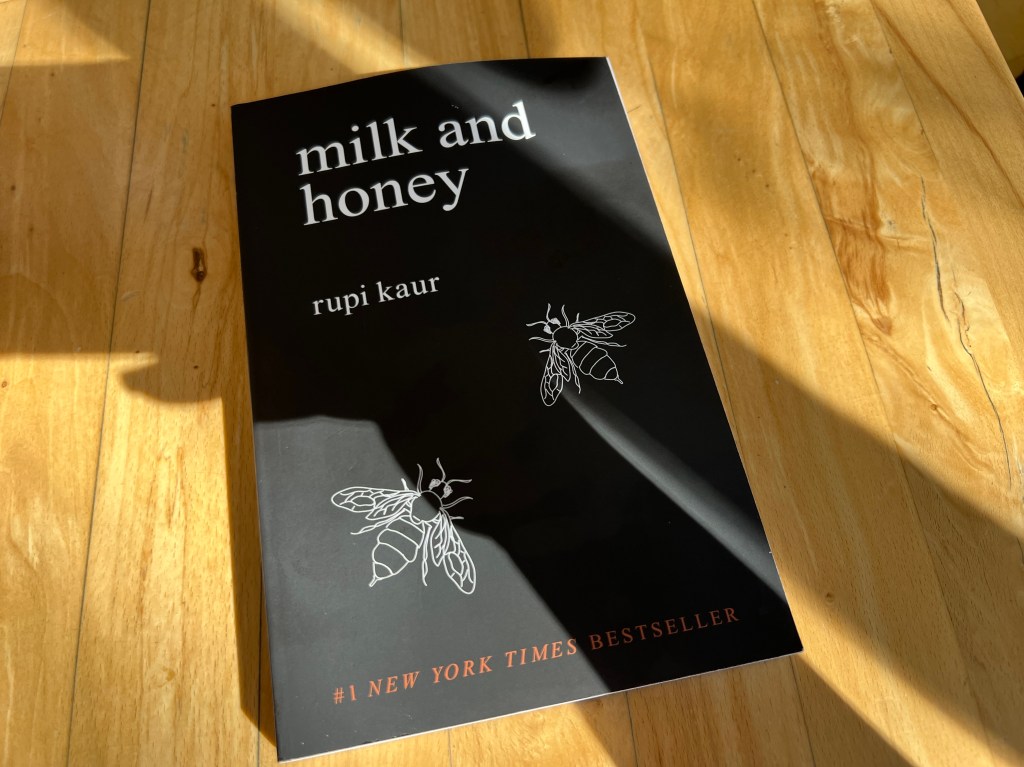
A few years ago, I found a copy of Milk and Honey on the sidewalk. Literally. It was sitting on the ground, almost pristine, as if dropped or deliberately left behind by someone who had outgrown it, or perhaps someone who wanted it to be found. I had, up to that point, only encountered snippets of Kaur’s poetry through Instagram and occasional glances in Barnes & Noble. I’d made a kind of offhand promise to myself: if I were ever going to own this book, the universe would have to give it to me. And then it did. On a sunny afternoon, on my way to the MacArthur BART station, there it was—an unexpected gift or cosmic joke, depending on how one reads it.
I cracked it open while walking. The matte cover was pleasant to the touch, a small tactile pleasure. But I was immediately struck by the production choice: white offset paper. Bright, thin, slightly too sharp. It gave the book the aura of a high school literary journal—something rushed to print, earnest and raw but not quite elegant. It lacked the quiet gravity of books designed to last. By contrast, Billy Collins’ recent collection Musical Tables—a masterclass in brevity, some might say—was printed on creamy, archival paper. The physical object exuded restraint, timelessness, and above all, pedigree.
There’s symbolism in that contrast. The form, the packaging, the paper—it all reflects the literary culture surrounding the work. When poets like Billy Collins critique social media poetry, the subtext is clear: this kind of writing is whimsy. It’s too easy. It lacks discipline. And to be fair, writing very short poems well does require discipline. More than that—it requires a particular kind of precision. A short poem must be condensed thought, concentrated emotion. Every syllable, every space, matters.
I’m not an expert, but I’ve been trained by some. In undergrad and graduate programs, we were taught that the shorter the poem, the more it must hold. Haiku, for instance, is a marvel of constraint—three lines, five-seven-five syllables, and yet entire seasons can live inside those seventeen syllables. Ezra Pound understood this when he wrote In a Station of the Metro. So did William Carlos Williams, with The Red Wheelbarrow. Even Ernest Hemingway, never one to be sentimental, experimented with micro-fiction — Baby Shoes. Constraint, paradoxically, is what gives these tiny forms their immense power.
So where does Rupi Kaur fit into that lineage?
Rereading Milk and Honey, I found myself less dismissive than I’d expected. I remembered that I had once written a quick review of it—something careless yet well thought of—buried somewhere in the dusty archives of an old blog. But this time, I wanted to read with curiosity rather than judgment. I wanted to understand why these poems resonated so deeply with millions, particularly millennial women who first discovered them in their teens and returned to them in their thirties.
And I think I do understand it now.
There is a clarity to Kaur’s work. An emotional bluntness that doesn’t try to be metaphorical. The technique, while often rudimentary, is consistent. She employs certain patterns, certain gestures that act like emotional shortcuts. These misdirections—or perhaps strategies—are familiar:
- There is a subject, but the execution is vague enough to allow projection.
- The language is simple—elementary, even—which increases accessibility.
- The poems tell rather than show, but this directness performs as vulnerability.
- They are melodramatic, but not insincere.
- The line drawings, minimalist and feminine, supplement the tone of the text and create a recognizable aesthetic.
This isn’t the poetry of the academy. It isn’t attempting to impress a panel of tenure-track professors. But that’s precisely the point. It’s not trying to impress anyone except the reader, directly—and often, tenderly.
Personally, I no longer gravitate toward this kind of poetry. My tastes have shifted. I’ve read more. I’ve grown older. I want more complexity, more ambiguity, more strangeness in language. But I wouldn’t call Kaur’s work unintelligent or dismiss it as entirely shallow. What she offers is an invitation. A gateway. And that matters. Because the best readers—the ones who stay curious—don’t stop with one book. They keep going. Taste evolves. It refines itself through exposure, through challenge, through delight and disappointment alike.
What do the kids say now? It’s not that deep. And maybe that’s true. But for readers without formal training—those without the alphabet of degrees after their names—reading is supposed to be pleasurable. It is supposed to feel like something. And Milk and Honey, for all its polarizing reputation, feels.
It’s the literary equivalent of a young adult romance novel, but soaked in trauma and tears. It is not that deep, but I feel it in my tendons kind of poetry. For some readers, it is the first time they see their pain named and for many, that’s all a book needs to be.
 𝐃 𝐗 𝐌 𝐈 𝐍 𝐈 𝐐